걱정하지 마세요. 지금 당장 우리 사장님께 연락하세요.
서둘러 닫지 마시고, 지금 바로 저희 사장님께 직접 말씀해 주세요. 보통 1시간 이내에 답변해 드립니다.
중국 최고의 PCB 레이저 다패널링 기계 제조업체
원스톱 PCB 디패널링 솔루션
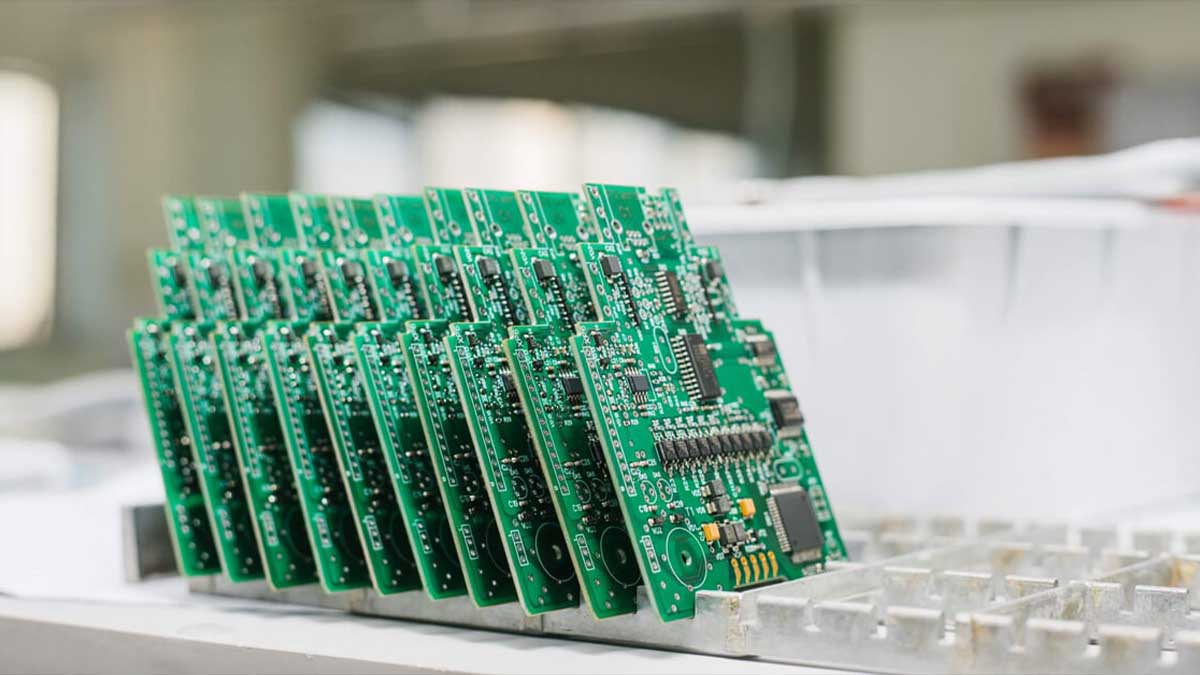
Then, during the absolute final step of separating the panels, a mechanical router bit dulls, vibrates, and causes a microscopic fracture in a $500 medical PCBA.
If your Electronic Manufacturing Services (EMS) facility is struggling with high rework rates, latent component failures, or unacceptable scrap levels during the final board singulation phase, mechanical routing is likely the culprit. The permanent solution we implement for high-end EMS providers is migrating to a contactless pcb laser cutting machine. By utilizing cold ablation, we guarantee zero mechanical stress, completely eliminating vibration-induced microcracks in sensitive components like MLCCs. This upgrade not only secures your yields but immediately qualifies your production lines for high-margin automotive and medical contracts.
As solutions experts who spend our days walking the floors of high-mix, low-volume (HMLV) SMT assembly factories, we hear the exact same frustration every single week. You successfully print the solder paste, accurately place thousands of micro-components, pass Automated Optical Inspection (AOI), and survive the reflow oven. Then, during the absolute final step of separating the panels, a mechanical router bit dulls, vibrates, and causes a microscopic fracture in a $500 medical PCBA.
You’ve just lost the bare board, the expensive components, and the labor hours.
For contract manufacturers dealing with high-density interconnects (HDI), medical-grade electronics, or automotive electric vehicle (EV) systems, traditional V-scoring and routing are no longer viable. Today, we are going to dive deep into the engineering data to explain why your rework rates are spiking, how to solve it permanently, and why upgrading to modern laser depaneling technology is the most profitable CapEx decision you can make this year.
In precision electronics, the margin for physical error is essentially zero. To avoid long-term reliability issues and latent micro-cracking in sensitive components like Multi-Layer Ceramic Capacitors (MLCCs), engineers must maintain strict physical tolerances.
When you use a mechanical router or V-cut separation process, physical friction is applied to the FR4, polyimide film, or metal-core PCB (MCPCB). As the physical bit dulls—which happens continuously from the very first cut—shear forces and bending moments are transferred directly through the board substrate into your surface-mount components.
Industry consensus dictates a critical threshold for physical stress. As a golden rule in high-reliability PCB manufacturing, engineering teams must keep mechanical stress below 200 microstrain to avoid latent component failures [Source: businessresearchinsights].
When mechanical routers vibrate or V-score blades apply extrusion stress, they routinely exceed this 200 microstrain limit. What happens next?
Expert Best Practice 1: Conduct a Strain Gauge AuditIf you are currently using mechanical routers, we highly recommend renting or purchasing a strain gauge. Attach it directly next to the cut line of your most component-dense panel. Run your standard routing program. If the gauge registers anything above 200 microstrain, you are actively introducing latent defects into your product. It is time to pause the line and re-evaluate your singulation method.
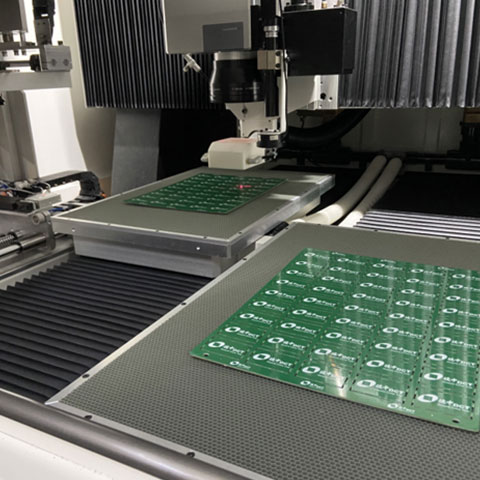
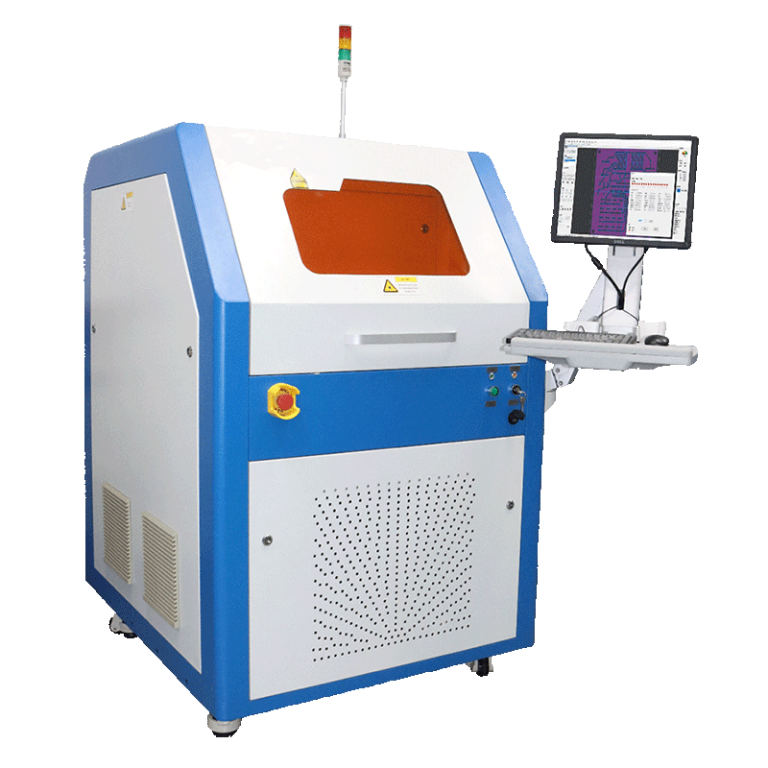
The definitive answer to vibration-induced rework is eliminating physical contact entirely. By upgrading to an automated pcb laser depaneling machine, EMS providers replace friction and physical shear forces with software-controlled light.
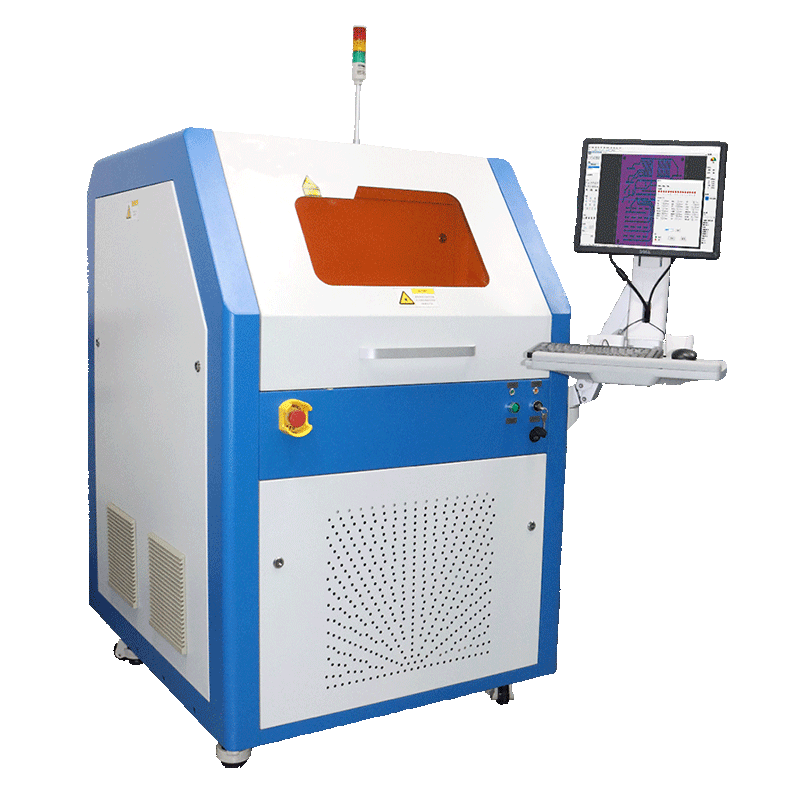
A common misconception we hear from SMT project managers is: “Won’t the heat from a laser damage our board edges?”
If you were using an outdated CO2 laser, thermal damage was indeed a risk. However, modern systems utilize UV Lasers (Ultraviolet). UV lasers perform what is known as “cold ablation.” Instead of melting the material, the UV laser optical beam operates at a wavelength that breaks the molecular bonds of the FR4, ceramic substrate, or FPC material directly. The material vaporizes instantly. The Heat-Affected Zone (HAZ) is microscopic, ensuring zero edge carbonization, zero discoloration, and absolutely no thermal stress transferred to adjacent components.
Contract manufacturers rarely cut just one type of board. You might run standard rigid FR4 boards in the morning, shift to flexible printed circuits (FPC) with delicate polyimide films in the afternoon, and process heavy metal-core PCBs (MCPCB) by night.
Mechanical systems require different router bits, different spindle speeds, and custom tooling jigs for each material change. With a modern uv laser depaneling system, the transition is completely software-driven. You load a different CAD file, the system adjusts the laser frequency and pulse energy, and you start cutting. It is an “all-in-one” solution for the high-mix smart factory.
We are not the only ones recognizing this shift. Global contract manufacturers are voting with their CapEx dollars. The transition away from mechanical stress is reshaping the SMT automatic line integration market.
Recent market analytics show that laser depaneling machines accounted for an estimated 34% market share in 2024 (valued at USD 105 million), specifically driven by the demand for stress-free cutting in miniaturized PCBs [Source: strategicmarketresearch].
Here is a breakdown of why high-value assembly lines are transitioning:
| Processing Metric | Mechanical Router System | Laser Depaneling System | Our Engineering Takeaway |
| Mechanical Stress | 200 to 500+ microstrain | 0 microstrain (Contactless) | Eliminates 100% of vibration-induced MLCC microcracks. |
| Kerf Width (Waste) | 2.0 mm to 3.0 mm | < 25 μm to 50 μm | Allows engineers to pack 15-30% more boards per production panel. |
| Component Clearance | Minimum 1.0 mm from edge | 0.1 mm from edge | Vital for extreme HDI boards, wearables, and high-density EV modules. |
| Edge Quality | Susceptible to burrs/dust | Burr-free, Dust-free | Meets strict IPC-A-600 Class 3 visual acceptance standards. |
Furthermore, the laser segment dedicated strictly to High-Density PCBs is projected to grow at a 7.4% CAGR through 2030. The data proves that if you plan to compete for modern contracts, you must adopt contactless separation.
Expert Best Practice 2: Redesign Your Panels for ROIWhen migrating to laser, do not use your old router panel designs! Because a laser beam has a kerf width of less than 50 microns, you no longer need to leave 2.5mm “mouse bites” or routing channels between your sub-panels. By updating your CAD layout to utilize zero-clearance cutting, we routinely help clients increase their material utilization by over 20%. The savings in bare board substrate alone often funds the new laser equipment.
While yield improvement is the primary driver, there are secondary operational benefits that fundamentally change how your factory operates.
If you manufacture for aerospace, automotive ADAS, or medical devices, your boards must comply with IPC-A-600 Class 3 standards. This standard explicitly looks at externally observable characteristics like board edge conditions, including burrs, exposed weave, and haloing. Mechanical routing shears the fiberglass and often leaves fraying or conductive copper dust on the edge. A laser cleanly vaporizes the edge, leaving a hermetically sealed, smooth finish that passes strict visual inspection every single time.
High-end OEMs demand complete part traceability. Modern EMS facilities require equipment that communicates with their Manufacturing Execution System (MES). When you implement an inline pcb depaneling system, the machine uses built-in vision cameras to read fiducial marks, 1D/2D barcodes, or QR codes on the fly. It links the exact cutting parameters, timestamps, and quality metrics to the board’s serial number before passing it down the SMEMA conveyor to the final packaging stage.
Let’s talk about Total Cost of Ownership (TCO). A mechanical laser routing machine (or standard spindle router) requires continuous maintenance. Router bits break, wear down, and must be replaced weekly. Custom physical holding jigs must be milled for every new board geometry. With a laser, the “tool” is software. You never buy a physical routing bit again, you never suffer from spindle vibration downtime, and custom holding fixtures are largely eliminated thanks to vacuum table technology.
Expert Best Practice 3: Shift the CapEx Conversation to TCOWhen proposing a laser upgrade to your CFO, do not present it merely as an equipment purchase. Present a TCO (Total Cost of Ownership) analysis. Calculate the monthly cost of: 1) Scrapped PCBAs due to cracking, 2) Labor hours spent manually breaking boards or reworking cracked components, and 3) Monthly consumable router bit purchases. In high-value manufacturing, a laser system typically pays for itself within 12 to 16 months through scrap reduction alone.
To illustrate how transformative this is, let us share a recent implementation case from a mid-sized EMS provider.
The Challenge: The factory was producing high-density diagnostic PCBAs for a medical OEM under ISO 13485 regulations. The board featured multiple highly sensitive ceramic capacitors placed less than 0.5mm from the board edge. During the standard router singulation process, the vibration was creating microscopic fissures in the capacitors. The boards passed visual AOI but randomly failed during final electrical reliability testing. Their rework rate hovered around 8%, destroying their profit margins on the contract.
The Implementation: We integrated an automated UV laser cutting solution directly into their assembly line. We utilized the system’s vision alignment to ensure cutting accuracy down to ±25 μm.
The Results:
To wrap up, here are the top 5 questions we receive from engineering managers looking to make the transition.
Yes, particularly for high-mix or complex geometries. While a mechanical saw might cut a straight line in thick FR4 slightly faster, laser systems completely eliminate the downtime associated with changing router bits, resetting physical jigs, and performing QA rework. For modern automated lines, the overall throughput and yield of an inline laser system provide a significantly higher net output of good boards per shift.
Honestly, no. We’re using modern UV lasers now, which work on what we call “cold ablation.” Unlike old-school $CO_2$ lasers that basically melt their way through, UV light snaps the molecular bonds at a chemical level using high-energy pulses. Since there’s almost no heat transfer, the “heat-affected zone” is a non-issue. You get a perfectly clean, burr-free edge with zero carbonization—no black soot, no charring.
Absolutely. That’s the beauty of a software-defined system. You aren’t tied down by physical drill bits or router bits. You can go from cutting a heavy 1.6mm rigid board for an automotive project to singulating a delicate 0.1mm polyimide flex circuit for a wearable—all on the same machine. It’s as simple as loading a different recipe file and hitting “Go.”
This is a game-changer for board density. With traditional V-scoring or routing, you’re usually forced to leave a 1.5mm to 3.0mm “safety buffer” to avoid vibration damage or micro-cracks. But because a laser is zero-stress (nothing is physically touching the board), you can push your components as close as 0.1mm to the edge. It’s a huge win if you’re trying to shrink your form factor.
Answer: It is remarkably straightforward. Modern systems are designed for Industry 4.0. They come fully SMEMA compliant, allowing them to interface directly with your existing automated loaders, unloaders, and conveyors. Furthermore, they feature built-in APIs to connect directly to your factory’s MES for real-time traceability and quality tracking.